The paper industry continues to evolve with changes in manufacturing, packaging, international trade, and customer demand. While price and product specifications remain important, today's paper buyers are increasingly considering supply reliability, product consistency, application suitability, production efficiency, and supplier communication.
For paper converters, printing companies, packaging manufacturers, tissue producers, and distributors, these factors can directly influence production and business operations. As a result, purchasing decisions are increasingly focused not only on the product itself, but also on the overall value and reliability of the supplier relationship.
1. From Price to Overall Purchasing Value
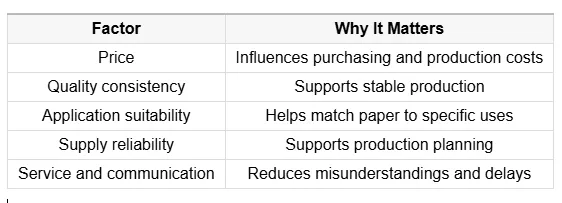
Price remains an important factor in paper purchasing, but the lowest purchase price does not always represent the lowest overall cost. Inconsistent paper quality can affect printing performance, converting efficiency, product appearance, and production stability. For example, packaging manufacturers need paperboard that performs consistently during cutting, folding, and forming, while printing companies require stable surface properties and runnability.
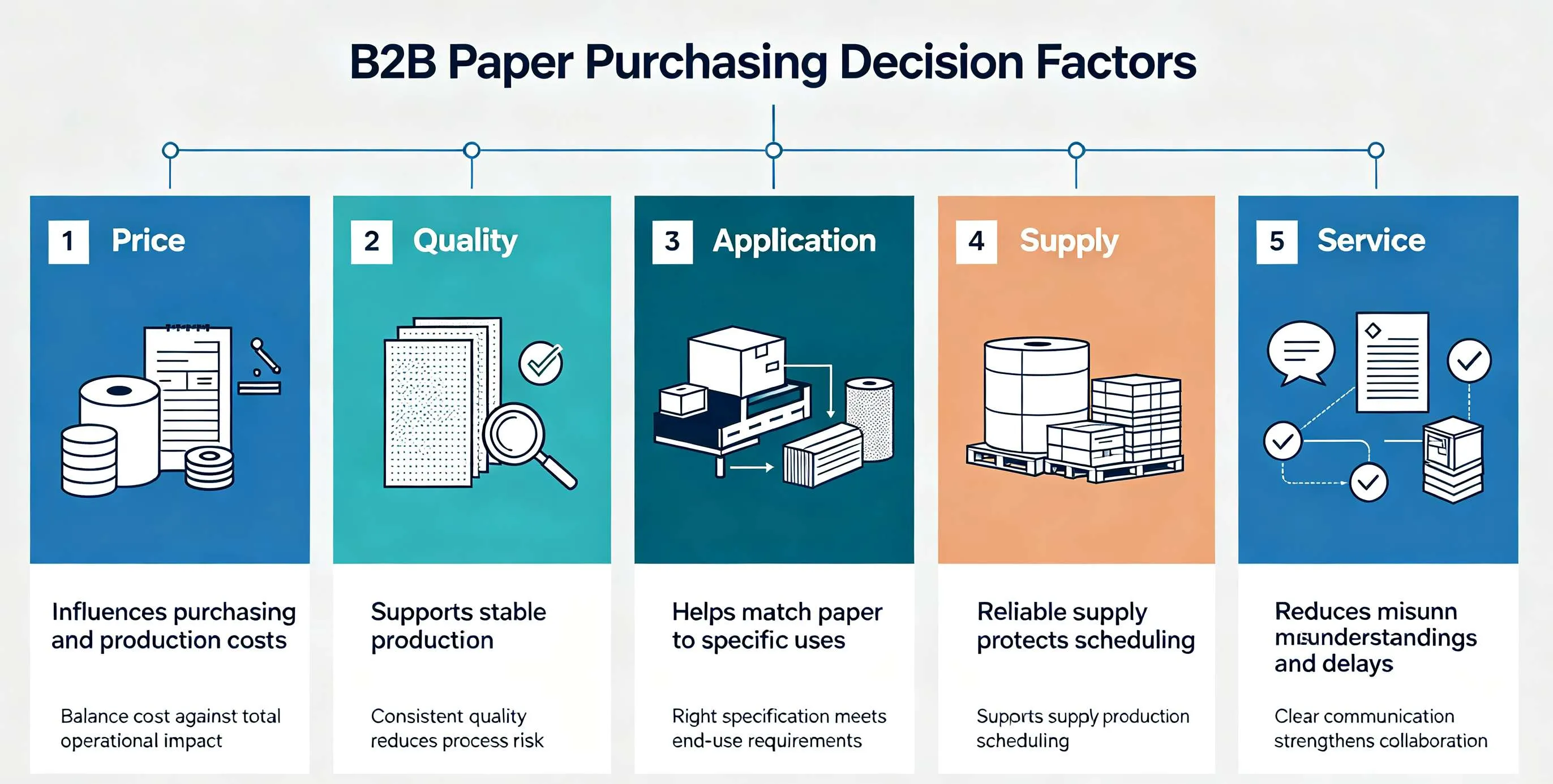
This means buyers increasingly need to consider price, quality, performance, and operational efficiency together when evaluating paper products.
Paper Purchasing Decision Factors
2. Supply Stability Is Becoming More Important
For businesses that consume paper regularly, reliable supply is closely connected to production planning and customer delivery schedules.
Packaging manufacturers may need to coordinate paperboard purchases with production capacity and customer orders. Distributors must also balance inventory availability with storage costs and market demand.
For international buyers, lead times and logistics can add another layer of complexity. Although suppliers cannot eliminate every disruption, realistic lead-time planning, clear communication, and timely updates can help customers manage supply uncertainty more effectively.
Suggested illustration: Paper rolls or paperboard being prepared for international shipment, with a visual connection between factory, logistics, and customer.
3. Product Consistency Supports Production Efficiency
Paper is often an input into a larger manufacturing process rather than simply a finished product. Its properties can influence printing, coating, converting, forming, and other downstream operations.
When paper properties vary between batches, manufacturers may need to adjust equipment or production parameters. This can consume additional time and resources.
For this reason, buyers often evaluate whether a supplier can reliably meet agreed specifications across repeated orders. Clear product specifications, quality control, and communication between suppliers and customers are important parts of maintaining consistency.
4. Customer Requirements Are Becoming More Application-Specific
Different applications require different paper properties.
Packaging materials may need to balance stiffness, printability, and converting performance. Food packaging materials may require consideration of the intended application and relevant functional properties. Printing papers can be evaluated according to surface characteristics, opacity, and runnability, while tissue materials may require properties such as softness, absorbency, and strength.
Therefore, selecting paper should begin with the intended application and production process, rather than relying only on a general product description.
Suggested Illustration: Application-Based Paper Selection
Show several end-use applications around different paper products:
Packaging → Printing → Food Packaging → Tissue → Industrial Applications
Each application can be visually connected to the relevant paper grade.
5. Communication Is Part of the Supplier Relationship
In international paper trade, effective communication is an important part of the purchasing process.
Buyers may need information about specifications, grades, packaging, order quantities, lead times, and delivery arrangements. Suppliers also need to understand the customer's application and purchasing requirements.
Clear communication can help both sides identify whether a paper grade is suitable before an order is placed. Over time, regular communication also allows suppliers to better understand changing customer requirements.
In this sense, service is part of the overall value of a paper supplier, alongside product quality and availability.
6. Long-Term Partnerships in a Changing Market
Long-term cooperation can help buyers and suppliers develop a better understanding of product requirements, purchasing schedules, and business expectations.
For buyers, working with a supplier familiar with their applications can simplify future product discussions. For suppliers, long-term relationships provide opportunities to understand customer needs and improve service.
Strong partnerships, however, are built through practical business experience. Consistent products, clear expectations, reliable communication, and transparent cooperation all contribute to long-term trust.
Looking Ahead: Creating Value Beyond the Product
The paper industry will continue to change alongside manufacturing, packaging, international trade, and customer expectations. Competitive pricing and product quality will remain important, but they are increasingly considered alongside supply reliability, application suitability, consistency, and service.
At China Paper, we believe that providing paper solutions begins with understanding how customers use paper and what they need from their materials.
By combining product knowledge, attention to customer requirements, and reliable communication, paper suppliers can support more effective cooperation throughout the supply chain.
Ultimately, the value of paper is not defined by the material alone. It is also reflected in how effectively it supports the customer's production process and business requirements.
China Paper — Paper Solutions for a More Sustainable Future.
 English
 français
 Deutsch
 Español
 italiano
 русский
 português
 tiếng việt
 Türkçe
 العربية
 Indonesia